Although I like food and highly recommend it, I'm not a foodie.
However, I do try to make a few decisions that might make a difference. For example, I buy free-run eggs. But, being honest, I have never really noticed a qualitative difference between these eggs and the allegedly evil eggs that come from battery cage chickens. I don't think keeping chickens in battery cages is very nice, but it doesn't seem to negatively effect the visceral quality of the egg, in my experience.
Well, that's not completely true -- the shells of the free-run eggs I normally buy seem thinner and more fragile than the eggs from the conventional source. Sometimes almost paper-thin.
For some time, I have been buying Rowe Farms's Green Valley eggs -- the ones with the occasionally flimsy shells -- but the other day I went to a different supermarket and needed eggs, so got some from another source -- Conestoga Farms, which looks like it's a label of the Gray Ridge conglomerate.
I was surprised to see how deeply orange the yolks of these other eggs were. Just like the foodies said, these are great eggs because the yolks are so orange!
These eggs contain 1mg of Lutein, the box said! Wow, I never knew I needed it. But it is a byproduct of their addition of marigold extract, which contains this substance.
They don't mention that marigolds are a deeply orange flower and that an extract would only concentrate this colour further, essentially making it a dye. So, my free-run eggs are deeply orange because the chickens have been fed natural food dye. I am not making this up.
What other foodies am I tired of? Jamie Oliver. I think he's a great presenter and I buy most of his cookbooks, which are always top-quality. But the Food Revolution series he's working on is incredibly dishonest and manipulative. For half of the statements he makes, I find myself turning it around on his own cause and asking another question, which is never answered.
As far as I got into the second series, he had somehow connected the formulation of a fast food burger patty with diabetes and suggested that using a homemade patty would be somehow reduce diabetes risk. Though he is leading in his presentation far more than he is direct, that is his implication. Really? Could he find anyone to back him up on that? I'd be surprised. In one demo where he fills a school bus full of the sugar consumed by some student population in the course of a year in front of horrified parents, I want him to do the same with the olive oil, flour, butter, and cream they'd be using if they followed his often pasta-centric recipes and see what they think of that sight.
And with all his talk of the "obesity epidemic", I'd also like someone to tell us whether Jamie Oliver himself is clinically obese or overweight according to the Body-Mass Index that categorizes us as such.
Sunday, June 05, 2011

Saturday, June 04, 2011
Inaccurate weather forecasting, and a few comments on car culture/pathology in Georgetown, Ontario
Although I shouldn't have been surprised, I went out for a long errand-running walk -- about 2 hours -- this morning with just shorts and t-shirt, foolishly trusting of The Weather Network's forecast of "isolated showers" this morning. It was "showering" when I left, but if that had been the worst of it then it would have been fine.
But by the time I was about halfway home, those showers had turned into a steady light rain. Three-quarters home and it was steadily raining. Within 5 minutes of home, it was a torrential downpour with significant thunder and lightning. I arrived home with leaking shoes, a see-through wet t-shirt, and a new hairdo.
It is still steadily raining as I type -- 3 hours since I set foot into those showers. Apparently, a severe thunderstorm warning cropped up while I was out, and the TWN forecast still shows a 40% chance of precipitation this afternoon -- the afternoon being about 15 minutes away.
One thing I should add about Georgetown that it is a car-insane place to live. At almost every opportunity for an altercation with a car (i.e. road entrances/exits), I had one. At some point, it starts to feel like a challenge. The main roads were steadily busy before 9am to the extent that it was difficult to cross without going way out of my way to use a "crosswalk" far off in the distance.
This car addiction really does come across as a mental illness when you spend a lot of time getting around town on foot. There is no excuse for it and I am certain that most of these trips are frivolous and redundant. If there is any politican that wants to hike gas taxes and devise a way to put a flat per-kilometre charge on driving -- period! -- I will to support him or her.
My main point, though, was going to be about weather forecasts. There have always been jokes about weather forecasts. People who aren't scientifically-capable have always joked about their inaccuracy. But these past couple of years have been different, I think. They are almost habitually inaccurate, unless a weather system is so large that it would be impossible not to get it right. I can't count on two hands the number of times I've been told this year of "isolated showers" or "variable cloudiness", only to find myself in the middle of a steady downpour.
Is this related to climate change, I wonder? Do the old models no longer work? We seem to be having problems like that with our economy at the moment -- past experience is no indicator of future experience. We were meant to be well into recovery mode by now.
The Weather Network's long-range forecast has always been a joke and I don't know why they bother publishing it (maybe it's that Web 2.0 tendency to force your customers to test your software for you), but even their short-range forecasts are unreliable lately and I am starting to distrust them. Environment Canada is not much better. On any given day, one or the other might be right, but one isn't consistently the one that gets it right so you can't pick a winner.
But I am only starting to distrust them. My experience today is evidence that I'm not all the way there yet.
But by the time I was about halfway home, those showers had turned into a steady light rain. Three-quarters home and it was steadily raining. Within 5 minutes of home, it was a torrential downpour with significant thunder and lightning. I arrived home with leaking shoes, a see-through wet t-shirt, and a new hairdo.
It is still steadily raining as I type -- 3 hours since I set foot into those showers. Apparently, a severe thunderstorm warning cropped up while I was out, and the TWN forecast still shows a 40% chance of precipitation this afternoon -- the afternoon being about 15 minutes away.
One thing I should add about Georgetown that it is a car-insane place to live. At almost every opportunity for an altercation with a car (i.e. road entrances/exits), I had one. At some point, it starts to feel like a challenge. The main roads were steadily busy before 9am to the extent that it was difficult to cross without going way out of my way to use a "crosswalk" far off in the distance.
This car addiction really does come across as a mental illness when you spend a lot of time getting around town on foot. There is no excuse for it and I am certain that most of these trips are frivolous and redundant. If there is any politican that wants to hike gas taxes and devise a way to put a flat per-kilometre charge on driving -- period! -- I will to support him or her.
My main point, though, was going to be about weather forecasts. There have always been jokes about weather forecasts. People who aren't scientifically-capable have always joked about their inaccuracy. But these past couple of years have been different, I think. They are almost habitually inaccurate, unless a weather system is so large that it would be impossible not to get it right. I can't count on two hands the number of times I've been told this year of "isolated showers" or "variable cloudiness", only to find myself in the middle of a steady downpour.
Is this related to climate change, I wonder? Do the old models no longer work? We seem to be having problems like that with our economy at the moment -- past experience is no indicator of future experience. We were meant to be well into recovery mode by now.
The Weather Network's long-range forecast has always been a joke and I don't know why they bother publishing it (maybe it's that Web 2.0 tendency to force your customers to test your software for you), but even their short-range forecasts are unreliable lately and I am starting to distrust them. Environment Canada is not much better. On any given day, one or the other might be right, but one isn't consistently the one that gets it right so you can't pick a winner.
But I am only starting to distrust them. My experience today is evidence that I'm not all the way there yet.
Sunday, May 22, 2011
Buried (but not valuable) treasure -- Yamaha-S90ES, Roland XV-5050
Cleaning up my hard drive, I found these musical experiments I'd made in the past. I may have posted them when I originally made them, but the links would be long-broken. This may be of interest if you want to hear the very good piano sound on the Yamaha S-90ES.
Piano (mostly Natural S from Yamaha S90ES)
S90-Sat
s90-idea1
s90_rambling
oncall
Piano plus accompaniment (mostly from S90ES, may contain some Roland XV-5050 parts)
mbg-4
mbg-15
mbg-20
mbg-24
mbg-18
Piano (mostly Natural S from Yamaha S90ES)
S90-Sat
s90-idea1
s90_rambling
oncall
Piano plus accompaniment (mostly from S90ES, may contain some Roland XV-5050 parts)
mbg-4
mbg-15
mbg-20
mbg-24
mbg-18
Saturday, May 14, 2011
A rainy day; things that thrive in a rainy garden; plus Steven Wilson
It's another rainy day today, and it has been a rather cool spring so far.
Still, some garden life obviously enjoys it immensely, as you can see below.
The sorrel seems to love it:

And so do the chives:


The sage also seems fine. The brown bits are last year's sage. The new growth is already well underway:

And the thyme seems to like its spot nestled under the other cedars:

Yesterday, I bought Steven Wilson's "Insurgentes" CD. He is English, and it is perfect music for this weather that can only be made by someone from that rainy and grey little island:
But I'm not saying he has Morrissey's "Everyday Like Sunday" beat in this regard:
But there's chili in the oven, so it's all tolerable.
Still, some garden life obviously enjoys it immensely, as you can see below.
The sorrel seems to love it:

And so do the chives:
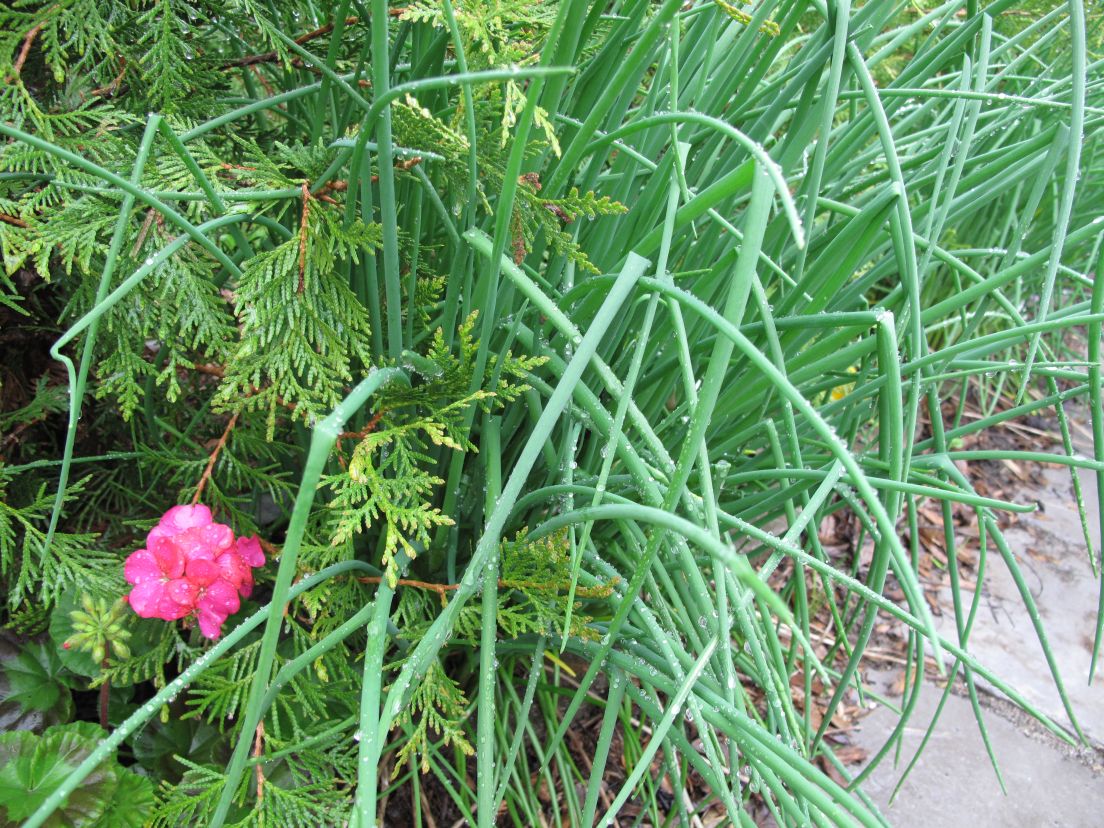
The cedars I planted last year obviously like it and are in need of a prune. I did some top-heavy pruning in early spring so decided to give them a chance to recover from that before doing the rest:

The sage also seems fine. The brown bits are last year's sage. The new growth is already well underway:

And the thyme seems to like its spot nestled under the other cedars:

Yesterday, I bought Steven Wilson's "Insurgentes" CD. He is English, and it is perfect music for this weather that can only be made by someone from that rainy and grey little island:
But I'm not saying he has Morrissey's "Everyday Like Sunday" beat in this regard:
But there's chili in the oven, so it's all tolerable.
Thursday, March 24, 2011
Japan's problems with nuclear have strengthened George Monbiot's positive opinion of it
In a Guardian column, environmental/green activist George Monbiot describes how the problems in Japan have strengthened his support for nuclear as a part of a power mix that includes renewables.
It is a balanced column that hits all the right notes.
It is a balanced column that hits all the right notes.
Wednesday, March 23, 2011
Chernobyl wasn't as bad as most of us imagined it was
Chernobyl and Three Mile Island seem to be the benchmarks for measuring how bad the current Fukushima Daiichi nuclear reactor problem is, with Chernobyl being the worst-case and Three Mile Island being a best-case in popular assessment.
But, since there have been so few nuclear accidents and the meaning of the scale is therefore vague, it's worth asking how bad Chernobyl really was. Real Clear Science attempts an explanation:
Meanwhile, how many coal mining accidents do we have every year? How many people die protecting sources of oil? How many die from issues related to the fumes produced when we burn these things? How much carbon dioxide do we produce getting agitated and talking about carbon dioxide emissions?
That's why Seth Godin's graph that I posted yesterday has some merit.
Why can't the same people who criticize the imaginary fear of terrorist threat levels organize in the same way around the limp threat of nuclear energy? These fears come from the same place -- something that you can't see and don't understand that could attack you in ways you least expect.
And the people who say that the structural safety models of these plants are flawed and that the risks of failure are unknowable would also have to accept that the threat models that predict the consequences of such a failure are also flawed and vastly over-state the danger.
But, since there have been so few nuclear accidents and the meaning of the scale is therefore vague, it's worth asking how bad Chernobyl really was. Real Clear Science attempts an explanation:
It is worth putting even the UN’s low casualty figures in perspective. As the report notes, over 1,000 onsite reactor staff and emergency workers received heavy exposure to high levels of radiation on the first day of the accident, and some 200,000 workers were exposed in recovery operations from 1986-1987. But only 50 had died of cancer 20 years later.A deficient reactor design, clear breach of operational protocol, possibly drunken operators... and this is the worst we have ever seen from nuclear.
Exposed children are more at risk from thyroid cancer, but the recovery rate – even in the Soviet Ukraine – was 99 percent. The health experts could find no evidence of increased rates of leukemia or other cancers among the affected residents.
Meanwhile, how many coal mining accidents do we have every year? How many people die protecting sources of oil? How many die from issues related to the fumes produced when we burn these things? How much carbon dioxide do we produce getting agitated and talking about carbon dioxide emissions?
That's why Seth Godin's graph that I posted yesterday has some merit.
Why can't the same people who criticize the imaginary fear of terrorist threat levels organize in the same way around the limp threat of nuclear energy? These fears come from the same place -- something that you can't see and don't understand that could attack you in ways you least expect.
And the people who say that the structural safety models of these plants are flawed and that the risks of failure are unknowable would also have to accept that the threat models that predict the consequences of such a failure are also flawed and vastly over-state the danger.
Glad for a lack of "meaningful" Canada Pension Plan reform
Although, like most people, I don't understand why we need another federal election in Canada, I am glad that the Minister of Finance didn't give in to certain demands from the NDP -- their only realistic source of saving grace in this cycle -- such as an overly-unrealistic increase in Canada Pension Plan benefits.
I'm not opposed to restructuring the Canada Pension Plan, but I am opposed to increasing payouts from the plan in a way that pays out to a person that isn't commensurate with the amount that that person paid in.
In other words, if they want to say that you have to contribute an extra X dollars to the plan every year and that, as a result, you'll receive Y more dollars in benefit when you are retired, then I am OK with that. But I'm not OK with saying that you've paid in X dollars all your life and were told you'd be getting Y dollars when you retire, but now that you're close to retirement and haven't put enough money aside, we're going to give you more than Y dollars without requiring you to make any significant additional contribution to the CPP, seeing as you don't have many working years left. The missing part of this story, of course, is that people like me would be footing the bill for it.
As I understand it, if you're an immigrant to this country who arrives in mid-life, you are allowed to participate in the pension plan to the extent that you've contributed. You wouldn't, for example, receive the same pension upon retirement as someone who had been contributing for their entire working life.
Why should it be any different for a non-immigrant?
I'm not opposed to restructuring the Canada Pension Plan, but I am opposed to increasing payouts from the plan in a way that pays out to a person that isn't commensurate with the amount that that person paid in.
In other words, if they want to say that you have to contribute an extra X dollars to the plan every year and that, as a result, you'll receive Y more dollars in benefit when you are retired, then I am OK with that. But I'm not OK with saying that you've paid in X dollars all your life and were told you'd be getting Y dollars when you retire, but now that you're close to retirement and haven't put enough money aside, we're going to give you more than Y dollars without requiring you to make any significant additional contribution to the CPP, seeing as you don't have many working years left. The missing part of this story, of course, is that people like me would be footing the bill for it.
As I understand it, if you're an immigrant to this country who arrives in mid-life, you are allowed to participate in the pension plan to the extent that you've contributed. You wouldn't, for example, receive the same pension upon retirement as someone who had been contributing for their entire working life.
Why should it be any different for a non-immigrant?
Subscribe to:
Posts (Atom)